


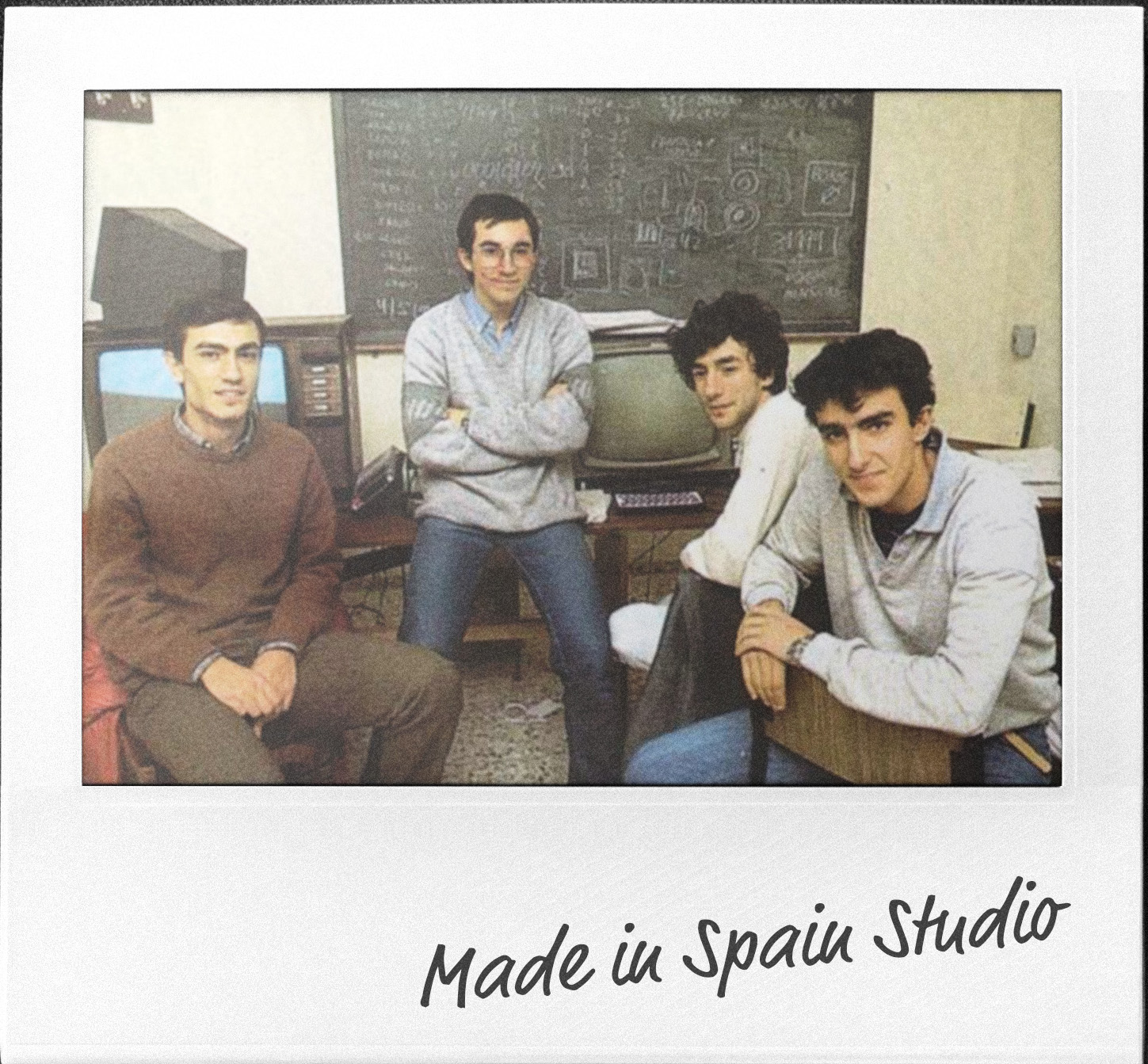
From left to right: Cela, Granados, Menéndez and Rada. Input Sinclair, Madrid (Spain), February 1986.
Fred is an action video game developed by Carlos Granados (Charlie), Fernando Rada and Paco Menéndez for the Sinclair ZX Spectrum in 1983, and published by Indescomp, SA in Spain and by Quicksilva, Ltd in the UK, with cover art by David Rowe. Versions for Commodore 64 and Amstrad CPC 464 were released throughout 1984.
This title incorporates features that are now associated with games such as Rogue, including procedurally generated mazes, map exploration, resource management, and a high level of difficulty, anticipating some of the mechanics that would later come to define the roguelike genre. In this respect, it represents one of the earliest Spanish video games to incorporate characteristics that would later become hallmarks of the genre.
Together with its contemporary Bugaboo (The Flea), Fred is one of the landmark titles of the early years of video game development in Spain. Regarding its release, it is worth noting that Indescomp reached an agreement to publish both games in the United Kingdom during the autumn of 1983, when they had already been completed. However, for logistical and promotional reasons, their releases were staggered by a few weeks: Bugaboo was released at the end of that year, while Fred followed in early 1984. Both titles became major commercial successes and received widespread critical acclaim.
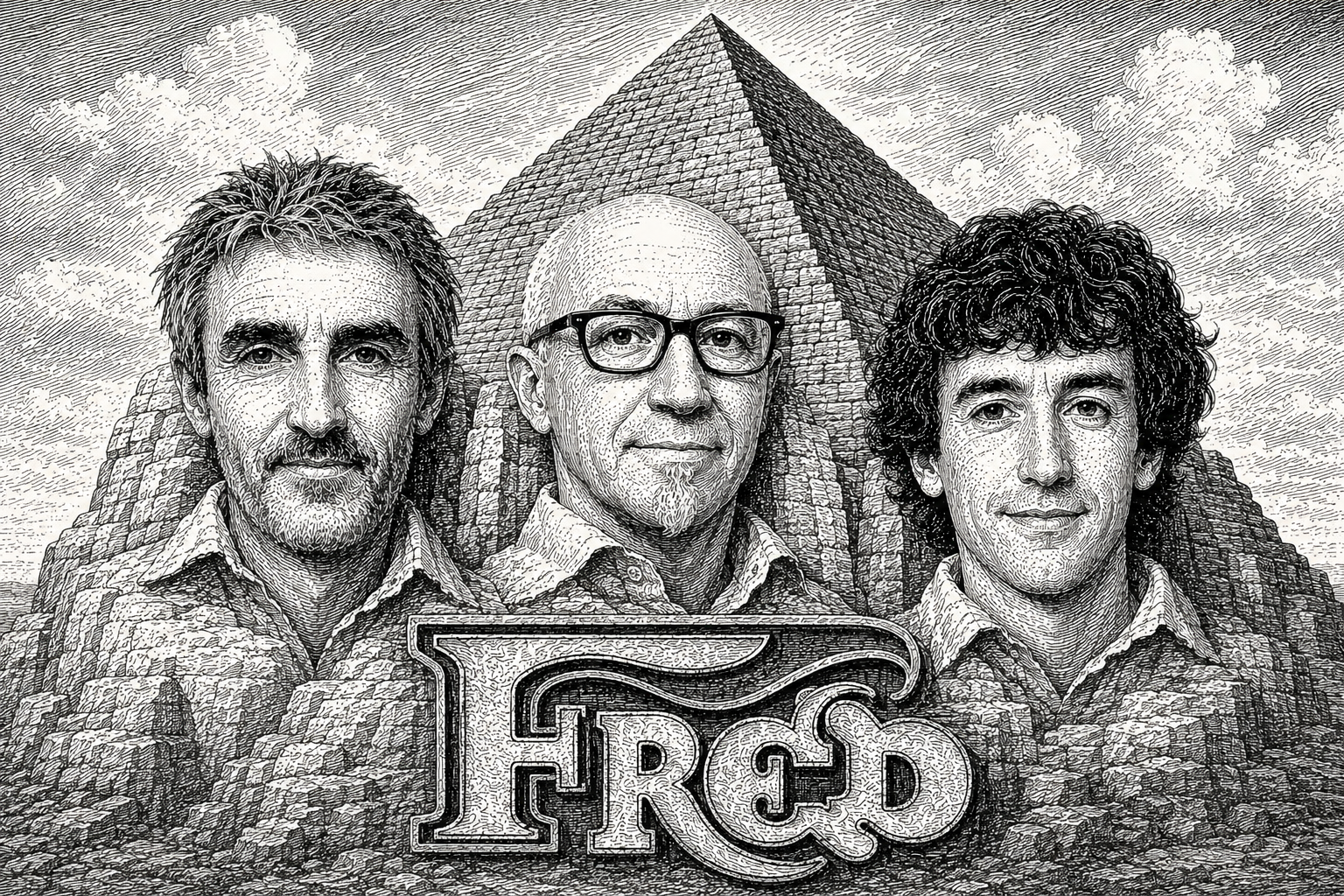
A Mount Rushmore-style recreation of the Fred team.
The Amstrad CPC conversion was developed by the same team, joined by Camilo Cela. It was published by Amsoft in the spring of 1984 under the title Roland on the Ropes as part of the well-known Roland series of video games. Interestingly, Alan Sugar, Chief Executive of Amstrad, named the series after Roland Perry, the engineer who led the development of the CPC 464, while watching a demonstration of Fred.
The Commodore 64 version was developed exclusively by Pedro Ruiz, an expert on the platform and a member of Indescomp’s programming team.
The history of Fred starts when Granados played the game Pengo at an arcade during the summer of 1983. In Pengo the player controls a penguin that must move or destroy ice blocks in a maze to kill enemies and find the exit. At the beginning of each level the maze is generated randomly in front of the user. Charlie, who had just graduated high school and was about to start his Physics degree, was fascinated by the maze generation, and challenged himself to write a similar algorithm in his Spectrum computer. He quickly completed it, and had the idea that the random maze could be used for a video-game.
After his summer vacation Charlie got together with his friends, Fernando and Paco, and they set the basis for the game: the goal would be to exit the maze; the main character would be an adventurer, like Indiana Jones, with a gun to fight the enemies; and the setting, a pyramid. They completed the game in just a few weeks.
Fred received very positive reviews by the specialized press. Crash Magazine (issue 3, p84) gave it a score of 83%, noting “The game has great animation, especially that of Fred himself, and the graphics are generally excellent. Even Fred’s revolver recoils when it is fired”. Your Computer (April 1984 issue) gave it 4 out of 5 stars, and described it as a “feast of Disneyesque graphics”. Your Spectrum (issue 3, p70) scored it 8 out of 10. And it got a 100% score on Home Computing Weekly (issue 52, p22).
After Fred, the team founded the game studio Made in Spain and the distributor Zigurat. They produced a long list of games for 8 and 16 bit platforms, and even a few arcade titles.